Free Worldwide Delivery

Secure payment
Free Worldwide Delivery
Secure payment

Price Promise

Friendly Support
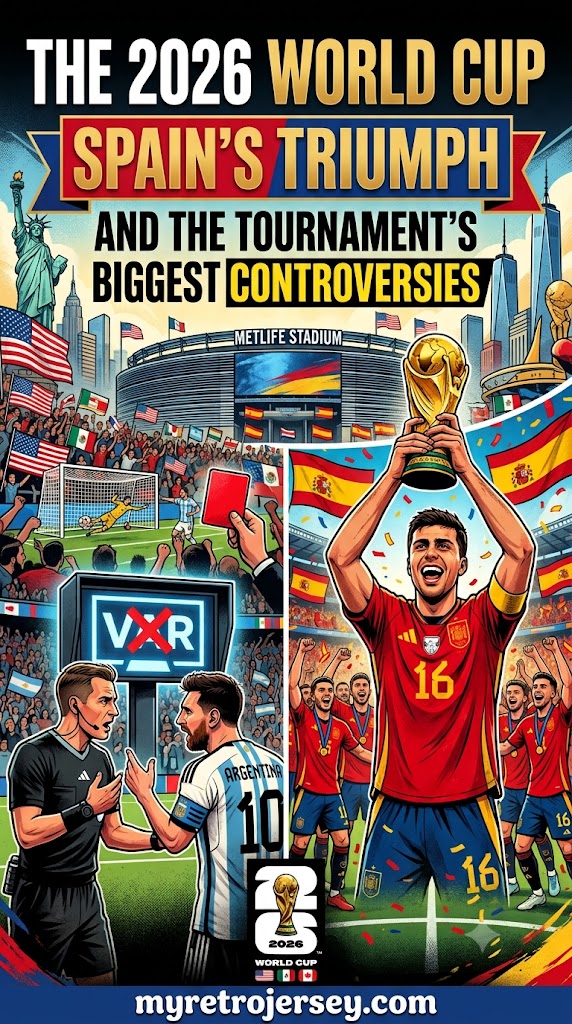
Spain are world champions again. In a tense final at MetLife Stadium in East Rutherford, New Jersey, Spain beat defending champions Argentina and Lionel Messi in a thrilling extra-time match in front of more than 70,000 fans. The only goal came deep into extra time, with Ferran Torres scoring the winner in the 105th minute of the contest, sealing what became Spain’s second World Cup title, its first since 2010.
A final built on defence, not fireworks
For a game with so much riding on it, the football was defined by resilience rather than spectacle. Spain dominated possession throughout, and its defence shut out Argentina almost completely, with the Argentines managing zero shots and only two touches in Spain’s box through halftime of extra time. On the other end, Argentina goalkeeper Emiliano Martínez made 11 saves, the most ever recorded in a men’s World Cup final, keeping his side in it deep into the closing stages. The breakthrough eventually came after Enzo Fernández was sent off for a reckless foul on Pau Cubarsí, and substitute Ferran Torres struck from close range for his first goal of the tournament.
It capped a run in which Spain didn’t allow a single shot on goal in the final and held a 20-2 shots advantage overall, continuing a defensively masterful campaign built around goalkeeper Unai Simón. The win also puts Spain in rare company — only France and Uruguay join them as multiple World Cup winners alongside England’s single 1966 title, and remarkably, Spain now holds both the men’s and women’s world titles simultaneously, with the Spanish women’s team also ranked number one and defending Women’s World Cup champions.
A tournament shadowed by VAR controversy
For all the celebration, this World Cup will also be remembered for how often the video assistant referee dominated the conversation. One of the most contentious moments came in the round of 32, when USMNT striker Folarin Balogun was sent off against Bosnia-Herzegovina following a VAR review. Argentina’s run through the knockouts was similarly dogged by controversy — Egypt had a second-half goal disallowed after VAR flagged a foul in the build-up on the opposite side of the pitch, in a game Argentina went on to win, a decision Egypt publicly protested after the final whistle.
The pattern followed Argentina all the way to the final. Tempers boiled over after the full-time whistle, with Nahuel Molina pushing Rodri as he ran to celebrate, and pundits noted the final itself was a bad-tempered match marred by Enzo Fernández’s red card for his foul on Cubarsí. Elsewhere in the tournament, decisions around Ghana’s penalty appeal against England, a disputed Belgium handball claim against Spain, and a series of millimetre-tight offside calls kept the debate about whether VAR is fixing or ruining the game running throughout the summer.
A fitting way to celebrate
Controversies aside, Spain’s route to the trophy was built on the kind of defensive discipline and tournament pedigree that’s defined the country’s football for two decades. If you were watching from home cheering every clearance off the line, there’s no better way to mark it than with a piece of Spanish football history — our Spain 1996 away shirt, along with the rest of the Spain collection, is live now.